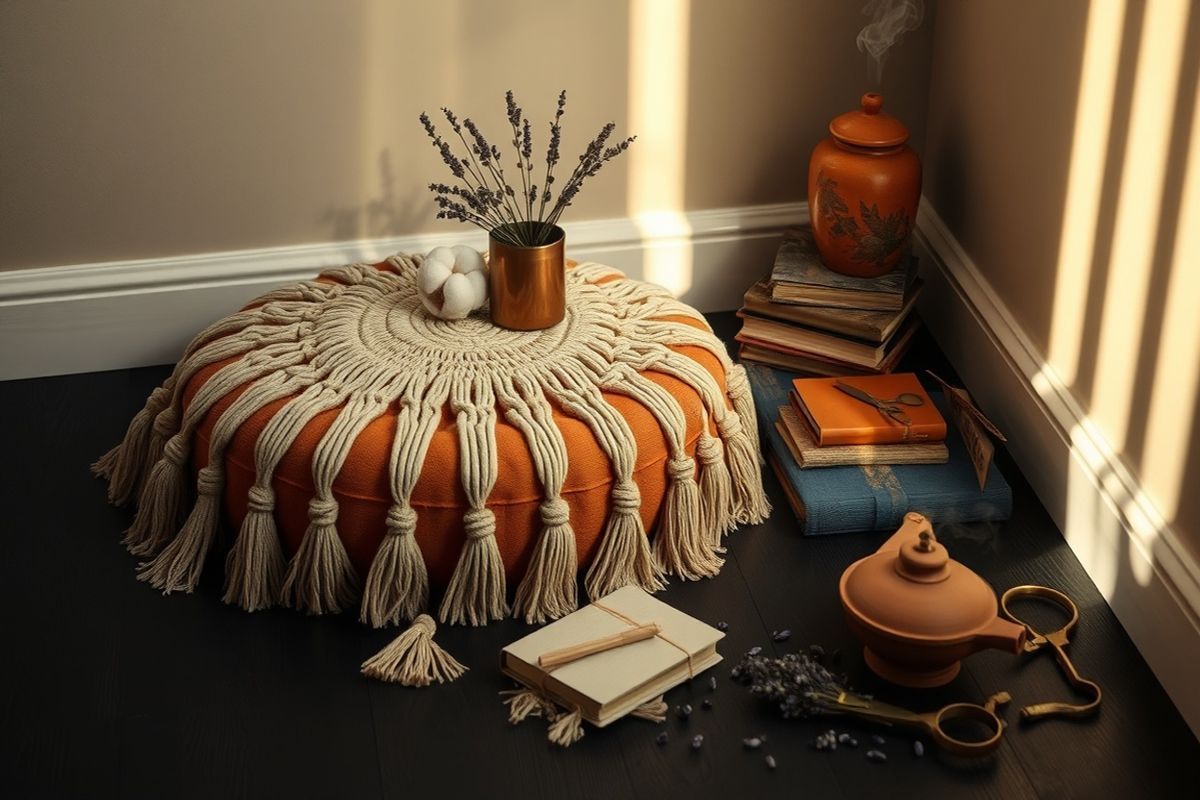
Hello, fellow home decor enthusiasts! Sara here from HomeReadyHub, and today we’re diving into a project that’s close to my heart: creating a beautiful, textural Bohemian macrame woven cushion. There’s something incredibly satisfying about crafting a piece that not only adds warmth and personality to your home but also tells a story of your own hands and creativity. Bohemian style, with its emphasis on natural materials, intricate textures, and a relaxed, free-spirited vibe, is perfectly embodied in a macrame cushion. It’s more than just a decorative accent; it’s a statement piece, a cozy invitation, and a testament to the timeless art of fiber crafts. Whether you’re a seasoned knot-tyer or just starting your macrame journey, this tutorial is designed to guide you through each step, ensuring you end up with a gorgeous, custom cushion that will be the envy of all your guests. Get ready to embrace the rhythm of knotting and weaving, and let’s bring some boho magic into your space!
Materials Needed
- Cushion Insert: One square cushion insert, 18x18 inches (45x45 cm) or 20x20 inches (50x50 cm) is a great starting point. Choose a size that fits your desired aesthetic.
- Macrame Cord: Approximately 300-400 yards (275-365 meters) of 4mm single-strand or 3-ply cotton macrame cord. The exact length will depend on your chosen knot pattern and cushion size. Natural, unbleached cotton is ideal for that authentic boho look.
- Fabric for Cushion Back: About 20x20 inches (50x50 cm) or 22x22 inches (55x55 cm) of sturdy fabric like linen, cotton canvas, or duck cloth. Choose a neutral color that complements your macrame cord.
- Sewing Machine: Or a strong needle and thread if you plan to hand-sew.
- Fabric Scissors: Sharp ones are a must for clean cuts.
- Measuring Tape or Ruler: For accurate measurements of cord and fabric.
- Pins: For securing fabric before sewing.
- Iron and Ironing Board: For pressing seams.
- Dowel Rod or Sturdy Branch: Approximately 24-30 inches (60-75 cm) long, for hanging your macrame project.
- S-Hooks or Clamps: To hang the dowel rod securely from a clothing rack, curtain rod, or sturdy hook.
- Tapestry Needle (Large Eye Needle): Useful for weaving in loose ends and for any decorative weaving.
- Optional Decorative Yarn/Roving: If you wish to incorporate weaving into your macrame panel, choose a contrasting or complementary yarn.
Preparation Steps
Step 1: Design and Measure Your Macrame Panel & Fabric
Before you start knotting, it’s crucial to plan your design and take accurate measurements. First, decide on the exact dimensions of your macrame front panel. For an 18x18 inch cushion insert, you’ll want your finished macrame panel to be roughly 18.5x18.5 inches (47x47 cm) to allow for a small seam allowance. For a 20x20 inch insert, aim for 20.5x20.5 inches (52x52 cm). This extra half-inch will give you a quarter-inch seam allowance on all sides when sewing to the back fabric.
Next, calculate your macrame cord lengths. A general rule of thumb for common knots like the square knot is that each working cord should be about 4-5 times the desired finished length of your project, and the filler cords (if any) should be about 2 times. For a cushion panel, where you’re creating dense knotting, it’s safer to err on the side of more cord. For an 18-inch panel, I’d recommend cutting individual strands of macrame cord to about 10-12 feet (3-3.6 meters) each. You'll need enough strands to cover the width of your cushion, typically requiring 20-30 strands depending on the cord thickness and knot density. To determine the number of cords, a good starting point is to measure how many cords (when folded in half for a Lark's Head Knot) fit snugly across 1 inch. Multiply that by your desired panel width. For example, if 4 cords fit in an inch, and your panel is 18 inches wide, you'll need 72 cords. This sounds like a lot, but you'll be folding them in half. So you'd cut 36 cords, each 10-12 feet long, and attach them using Lark's Head knots, giving you 72 working cords.
Finally, cut your back fabric. For an 18x18 inch cushion, cut your back fabric to 19x19 inches (48x48 cm). For a 20x20 inch cushion, cut it to 21x21 inches (53x53 cm). This gives you a generous half-inch seam allowance on all sides, making sewing easier.
Step 2: Set Up Your Workspace
A well-organized workspace makes a world of difference. Find a quiet, well-lit area where you can comfortably stand or sit for extended periods. Hang your dowel rod or sturdy branch from S-hooks or clamps. A clothing rack, a sturdy curtain rod, or even two chairs with the dowel resting across them can work. Ensure it's at a comfortable height for knotting – you want to avoid straining your back or shoulders. Lay out your pre-cut macrame cords, making sure they are untangled and easily accessible. If you're incorporating weaving, have your decorative yarns or roving ready. Prepare your sewing machine by threading it with a strong, coordinating thread and ensuring your bobbins are full. Clear a flat surface for cutting and sewing your fabric.
Assembly
Step 3: Crafting the Macrame Front Panel
This is where the magic happens! Begin by attaching your pre-cut macrame cords to the dowel rod using Lark's Head knots. Fold each cord in half, place the loop over the top of the dowel, bring the two ends up and through the loop, and pull tight. Space them evenly across the width you determined in Step 1. Once all cords are attached, you'll have double the number of working cords hanging down.
Now, let’s start knotting. A classic choice for a cushion is a series of square knots, which create a beautiful, dense texture. You can create rows of alternating square knots for a brick-like pattern, or combine them with half-hitch knots for more intricate designs. For a basic square knot, you’ll need four cords. Take the leftmost cord (cord 1) and cross it over the two middle cords (cords 2 and 3). Take the rightmost cord (cord 4), cross it under cord 3, over cord 2, and through the loop created by cord 1. Pull tight to form the first half of the knot. Then, reverse the process: cord 4 over cords 2 and 3, cord 1 under cord 3, over cord 2, and through the loop created by cord 4. Pull tight to complete the square knot. Repeat this process across your entire panel, working in rows. Maintain consistent tension with each knot to ensure an even, professional-looking finish.
If you're adding weaving, this is the time to integrate it. After a few rows of macrame knots, you can use your tapestry needle to weave in strands of decorative yarn or roving horizontally through your macrame work. This adds an extra layer of texture and color, enhancing the bohemian vibe. Simply pass the yarn over and under sections of your macrame cords, similar to traditional weaving, making sure not to pull too tightly to avoid distorting your macrame.
Continue knotting and weaving until your macrame panel reaches the desired length – remember to aim for approximately 18.5 or 20.5 inches, including any fringe you plan to leave at the bottom. Once you're happy with the length, carefully remove the macrame panel from the dowel rod. To finish the top edge, you can either leave the Lark's Head knots as they are or unknot them and weave in the ends using your tapestry needle for a cleaner finish. For the bottom, you can leave the cords as a natural fringe, trim them evenly, or create small knots to secure them.
Step 4: Assembling the Cushion Cover
Now that your stunning macrame panel is complete, it’s time to turn it into a functional cushion cover. First, lay your macrame panel flat and trim any uneven edges, ensuring it is square and matches the dimensions you planned (e.g., 18.5x18.5 inches). If your macrame panel has a lot of loose ends at the top or bottom that aren't part of a fringe, weave them in securely using your tapestry needle to prevent fraying.
Next, take your pre-cut back fabric. Place the macrame front panel and the back fabric right sides together. This means the 'good' side of your macrame (the side you want to be visible) should be facing the 'good' side of your back fabric. Align all edges carefully. Pin the two pieces together along three of the four sides. Leave one side completely unpinned and open – this will be where you insert your cushion. If your macrame panel is particularly thick or has a lot of fringe, ensure the pins go through both layers securely.
Using your sewing machine (or hand-sewing with strong stitches), sew along the three pinned sides. Use a straight stitch with a 1/2-inch (1.25 cm) seam allowance. Backstitch at the beginning and end of each seam to reinforce it. Once sewn, trim the corners diagonally close to the stitching to reduce bulk, being careful not to cut the stitches. Turn the cushion cover right side out and use a blunt tool (like a chopstick or the back of a pen) to gently push out the corners, making them sharp and neat. Give the sewn edges a good press with an iron to flatten the seams.
Now, it’s time for the moment of truth! Carefully insert your cushion filler into the open side of the cover. Gently work the cushion into all corners until it fills the cover completely and evenly. Once the cushion is fully inserted, you will need to close the remaining open side. You have a few options: you can hand-stitch it closed using a ladder stitch for an invisible seam, or you can machine-stitch it closed from the outside, creating a visible seam. If you're feeling ambitious, you could even add a zipper to this final seam for easy removal and washing, though for a first-timer, a simple hand-stitch is perfectly fine. And there you have it – your very own Bohemian macrame woven cushion, ready to adorn your sofa or bed!
Mistakes to Avoid
- Inaccurate Cord Lengths: Running out of macrame cord mid-project is frustrating. Always err on the side of cutting cords a bit longer than you think you’ll need. You can always trim excess, but you can’t add length!
- Inconsistent Knot Tension: This is a common pitfall. If some knots are too tight and others too loose, your macrame panel will look uneven and possibly warp. Practice maintaining a consistent, firm tension.
- Neglecting Seam Allowance: Forgetting to account for seam allowance when calculating your macrame panel and fabric dimensions can lead to a cushion cover that’s too small or oddly shaped. Always add that extra half-inch or so.
- Rushing the Process: Macrame is a meditative art. Rushing leads to mistakes, tangled cords, and frustration. Take your time, enjoy the rhythm of knotting, and take breaks when needed.
- Not Securing Ends Properly: Whether it’s macrame cord ends or fabric seams, ensure all ends are securely knotted or stitched. Loose ends can unravel your beautiful work.
- Ignoring Fabric Grain: When cutting your back fabric, ensure you're cutting with the fabric's grain. Cutting off-grain can lead to stretching and distortion when sewing and stuffing.
Pro Tips
- Use a Cord Calculator: For more complex macrame designs or larger projects, an online macrame cord calculator can be a lifesaver for estimating exact cord lengths.
- Practice Makes Perfect: If you’re new to macrame, practice your basic knots (Lark’s Head, Square Knot, Half Hitch) on scrap cord before starting your main project. This builds muscle memory and confidence.
- Experiment with Textures: Don't be afraid to incorporate different types of yarn, roving, or even thin strips of fabric into your weaving for added visual interest and tactile appeal.
- Consider a Zipper Closure: For a more professional finish and easy cushion insert removal for washing, consider adding a zipper to one of the seams of your cushion cover. There are many simple tutorials online for adding invisible or exposed zippers.
- Pre-Wash Your Fabric: If your back fabric is cotton or linen, pre-wash and dry it before cutting and sewing. This prevents potential shrinkage after your cushion is made.
- Dye Your Cord: For a truly unique piece, consider natural dyeing your macrame cord before you start knotting. Avocado pits, turmeric, and indigo can create stunning, organic colors.
- Lighting is Key: Work in a well-lit area to avoid eye strain and to clearly see your knots and stitches. Natural light is always best.
- Secure Your Macrame: When sewing the macrame panel to the fabric back, it can be helpful to baste (stitch loosely) the macrame edges to a piece of stabilizer or scrap fabric first, just inside your seam allowance, to keep it from shifting.
And there you have it! A comprehensive guide to creating a stunning Bohemian macrame woven cushion that will infuse your home with warmth, texture, and undeniable charm. This project is more than just crafting; it's an opportunity to slow down, engage your hands, and create something truly meaningful. Each knot you tie and every strand you weave contributes to a unique piece of art that reflects your personal style. Imagine curling up on your sofa, surrounded by the cozy comfort of something you made yourself – there’s really nothing quite like it. So, gather your materials, set up your space, and let your creativity flow. I can’t wait to see the beautiful cushions you bring to life! Share your creations with us on social media using #HomeReadyHubDIY. Happy knotting and sewing!